Every year, preventable accidents occur during equipment servicing—workers injured by unexpected machine startups, electrical surges, or pressurized systems releasing energy. These incidents often trace back to one root cause: missing or poorly implemented written lockout tagout procedures.
A written lockout tagout (LOTO) procedure isn’t just paperwork. It’s a step-by-step defense mechanism that protects maintenance and service personnel from hazardous energy. When followed correctly, it eliminates the risk of accidental energization. When ignored or poorly designed, it becomes a liability.
This guide breaks down the core components of effective written LOTO procedures, real-world examples, common pitfalls, and how to build protocols that work—not just satisfy regulators.
Why Written LOTO Procedures Are Non-Negotiable
Verbal instructions fail under pressure. Memory fades. Assumptions kill. That's why OSHA 29 CFR 1910.147 mandates written lockout tagout procedures for any machine or equipment that could release stored energy during servicing.
A written procedure ensures consistency, clarity, and accountability. It’s not a suggestion—it’s a legal and ethical requirement in manufacturing, utilities, processing plants, and any environment with complex machinery.
Consider a maintenance technician servicing a conveyor system. Without a written LOTO, they might isolate the main motor but overlook a hydraulic hold that retains pressure. When the system is re-energized, that pressure releases violently—resulting in lacerations or worse.
A written LOTO procedure would:
- Identify all energy sources (electrical, hydraulic, pneumatic, gravitational)
- Specify exact isolation points
- Define sequence for shutdown, isolation, and verification
- List required locks, tags, tools, and PPE
- Assign roles and responsibilities
In high-risk environments, verbal shortcuts are dangerous. Documentation is protection.
Core Elements of Every Written LOTO Procedure
A strong written LOTO procedure isn’t a single paragraph buried in a manual. It’s a clear, structured document designed for quick comprehension under operational stress.
Here are the essential components every written LOTO must include:
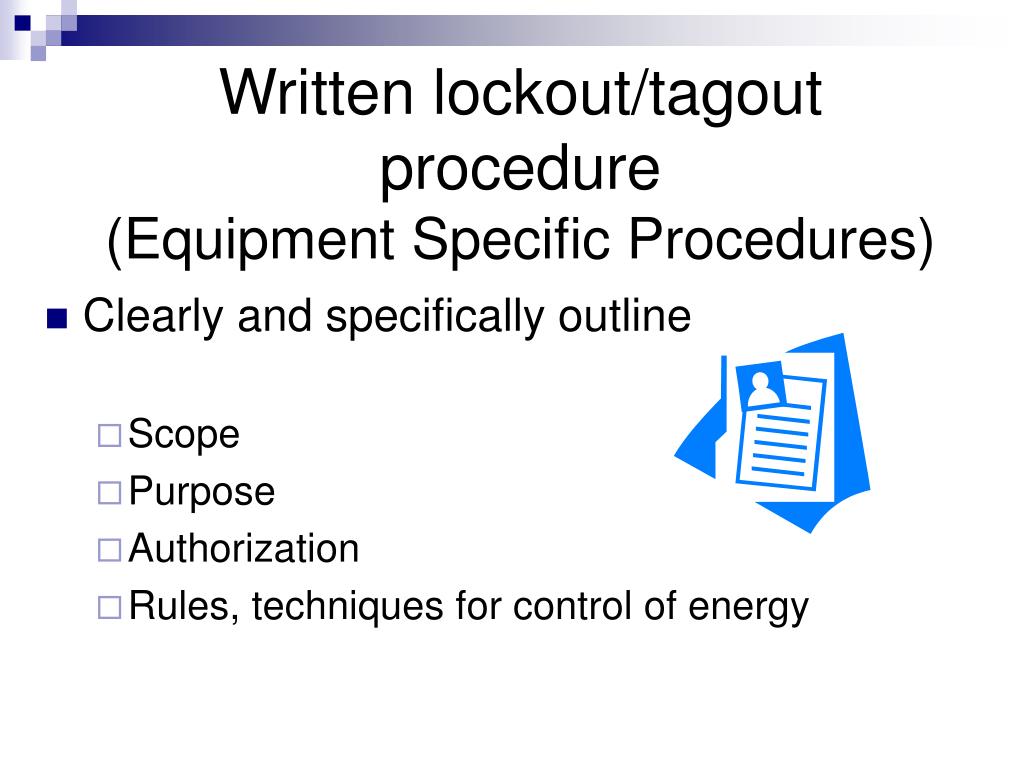
1. Equipment Identification Clearly name and uniquely identify the machine or system. Use asset numbers, location codes, or diagrams. Ambiguity causes errors.
Example: “Conveyor Line C-7, Packaging Area, West Wing—Motor ID: MC702”
2. Energy Sources and Isolation Points List every potential energy source: electrical circuits, pneumatic lines, hydraulic reservoirs, springs, gravity-fed systems.
Example: - 480V power feed (Circuit Breaker #CB12) - Pneumatic line (Valve #PV-09) - Accumulated tension in drive belt system
For each, specify the exact isolation mechanism: circuit breaker, lockable valve, mechanical pin, etc.
3. Shutdown and Isolation Sequence Provide a numbered, step-by-step shutdown process.
- Example:
- Notify operations supervisor of impending maintenance.
- Stop conveyor via HMI control panel.
- Engage emergency stop and verify motion has ceased.
- Open circuit breaker CB12 and apply group lockout device.
- Close and lock pneumatic valve PV-09 in “off” position.
- Release residual pressure via bleed valve.
4. Application of Locks and Tags Detail who applies each lock, what type of lock is used (e.g., keyed, combination, group lockbox), and what information appears on the tag.
Tag Requirement Example: - Employee name - Department - Date and time of lock application - Reason for lockout - Expected completion time
5. Verification of Zero Energy
This is the most critical step—and the most commonly skipped.
The procedure must require positive verification:
Example: - Use a multimeter to confirm zero voltage at motor terminals. - Test pneumatic lines with pressure gauge. - Physically check for movement or tension.
Verification isn’t optional. No verification = no safe work.
6. Restoration Steps Equally important: how to safely re-energize.
- Example:
- Confirm all tools and personnel are clear.
- Remove locks only by authorized individuals.
- Close pneumatic valve bleed point.
- Restore power at circuit breaker.
- Notify operations team before restart.
Real-World Use Cases and What Went Wrong
Case 1: Chemical Processing Plant A technician entered a mixing vessel to clean residue. The written LOTO covered electrical isolation but neglected agitator springs storing mechanical energy.
Failure Point: Incomplete energy source identification.
Lesson: Stored energy isn’t always obvious. Procedures must account for spring tension, gravity, and residual chemicals under pressure.
Case 2: Automotive Assembly Line Two technicians worked on different sections of the same robotic arm. Each applied their lock, but the line supervisor restarted the system after assuming “work was done.”
Failure Point: No group lockout protocol or communication procedure.
Lesson: Written LOTO must include coordination rules. Use group lockout boxes where multiple workers are involved.
Case 3: Food Processing Facility A night-shift worker bypassed LOTO because the “job only took two minutes.” The machine cycled unexpectedly, causing a hand injury.
Failure Point: Culture over compliance. Shortcuts normalized.
Lesson: Procedures must be enforced consistently. “Quick fixes” are never worth the risk.
Common Mistakes That Undermine LOTO Procedures
Even organizations with written LOTO fall short due to preventable errors. Watch for these:
- Vague language: “Turn off power” instead of “Open breaker #M3 and confirm zero voltage with multimeter.”
- Missing energy types: Ignoring hydraulic, thermal, or chemical energy.
- No verification step: Assuming isolation equals safety.
- Outdated documents: Procedures not updated after equipment modifications.
- Lack of training: Employees can’t follow what they don’t understand.
- One-size-fits-all templates: Generic procedures fail to address specific machine risks.
A procedure that looks compliant on paper but fails in practice is worse than no procedure at all—it creates false confidence.
How to Build Effective Written LOTO Procedures: A Workflow
Creating reliable LOTO documentation isn’t a one-day task. Follow this workflow:
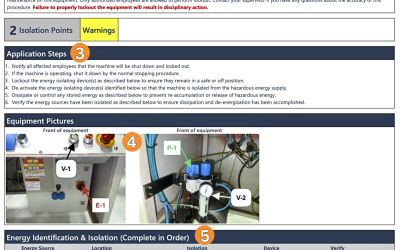
Step 1: Conduct a Machine Risk Assessment For each piece of equipment, identify:
- Energy types (electrical, mechanical, hydraulic, etc.)
- Isolation points
- Stored energy risks
- Access methods (entry points, guards, panels)
Use photos, diagrams, and input from maintenance staff.
Step 2: Draft the Procedure Use plain language. Avoid jargon. Structure it with bullet points or numbered steps. Include references to diagrams or schematics.
Step 3: Validate with a Dry Run Have a technician walk through the procedure without actual servicing. Time it. Note confusion points. Adjust wording.
Step 4: Train and Certify Employees must understand not just how but why each step matters. Training should include hands-on practice.
Step 5: Review and Update Annually Equipment changes. Processes evolve. Reassess every written LOTO at least once a year—or immediately after an incident.
Tools and Templates That Support LOTO Compliance
While written procedures must be customized, templates and tools streamline development.
Here are five practical resources:
| Tool | Purpose | Key Benefit |
|---|---|---|
| OSHA LOTO Standard Template | Baseline structure | Aligns with 1910.147 requirements |
| Lockout Tagout Procedure Software (e.g., EHS Insight) | Digital creation and tracking | Enables version control, audits, training logs |
| LOTO Diagramming Tools (e.g., Lucidchart) | Visualize isolation points | Improves clarity with flowcharts |
| Mobile LOTO Apps (e.g., Lockout.io) | Real-time access and verification | Technicians view procedures on-site |
| Lockout Procedure Generators (e.g., Creative Safety Supply) | Auto-generate drafts | Saves time on basic formatting |
These tools don’t replace human judgment—they enhance consistency and accessibility.
Industry-Specific Variations in Written LOTO While the core principles remain, application varies.
Manufacturing High machine density demands standardized formats. Group lockout boxes are common. Procedures often integrate with production scheduling systems.
Healthcare LOTO applies to medical equipment like MRI machines and sterilizers. Unique challenge: balancing patient safety with maintenance urgency.
Utilities High-voltage systems require dual verification and sometimes utility company coordination. Written procedures often include emergency override protocols.
Construction Mobile equipment (cranes, lifts) introduces environmental variables. Procedures must address dynamic worksites and temporary power sources.
The format may differ, but the goal is universal: eliminate uncontrolled energy release.
Closing: Make Written LOTO Part of Your Safety Fabric
A written lockout tagout procedure is more than compliance—it’s a cultural signal. It tells your team that safety isn’t situational. It’s systematic.
Start by auditing your current procedures. Are they specific? Are they used? Are they understood?
Then revise, train, and enforce. Use real incidents—not near-misses—as motivation. Post procedures near equipment. Digitize access. Audit routinely.
When an employee picks up a lock, they shouldn’t guess. They should follow the document that protects them.
Build procedures that are clear, thorough, and trusted. Because in the moment of risk, that piece of paper isn’t bureaucracy—it’s their lifeline.
Frequently Asked Questions
What is a written lockout tagout procedure? A documented, step-by-step process that outlines how to safely shut down, isolate, lock, and verify zero energy on machinery before maintenance.
Is a written LOTO procedure required by OSHA? Yes, OSHA 29 CFR 1910.147 requires written procedures for all machines and equipment that pose hazardous energy risks during servicing.
Who is responsible for creating LOTO procedures? The employer is responsible, typically with input from maintenance supervisors, safety officers, and equipment operators.
How often should written LOTO procedures be reviewed? At least annually, or whenever equipment changes, a near-miss occurs, or a new hazard is identified.
Can digital LOTO procedures be used instead of paper? Yes, as long as they are accessible, secure, up-to-date, and employees are trained to use them.
Do all machines need a written LOTO? Only machines with multiple energy sources or complex isolation. Simple devices with a single energy source may qualify for the “minor servicing” exception.
What happens if a LOTO procedure is not followed? Increased risk of injury or fatality, potential OSHA fines, legal liability, and damage to safety culture.
FAQ
What should you look for in Written Lockout Tagout Procedures: A Practical Guide to Safety? Focus on relevance, practical value, and how well the solution matches real user intent.
Is Written Lockout Tagout Procedures: A Practical Guide to Safety suitable for beginners? That depends on the workflow, but a clear step-by-step approach usually makes it easier to start.
How do you compare options around Written Lockout Tagout Procedures: A Practical Guide to Safety? Compare features, trust signals, limitations, pricing, and ease of implementation.
What mistakes should you avoid? Avoid generic choices, weak validation, and decisions based only on marketing claims.
What is the next best step? Shortlist the most relevant options, validate them quickly, and refine from real-world results.